Most toothaches are not root canal territory. A twinge from a cold drink, a day of soreness after a hard bite, mild sensitivity after a whitening session — these usually come and go without drama. But somewhere between an occasional twinge and a sleepless night of throbbing pain, a line gets crossed: the point at which the nerve inside the tooth is involved, and the problem stops being able to fix itself.
Knowing where that line is matters, because nerve-stage problems have a habit of escalating on their own schedule, not yours. This guide walks through the symptoms that suggest the pulp — the living tissue inside your tooth — is inflamed or infected, what your dentist actually does to confirm it, and why the phrase 'root canal' should trigger far less dread than it usually does.
A quick tour of the inside of your tooth
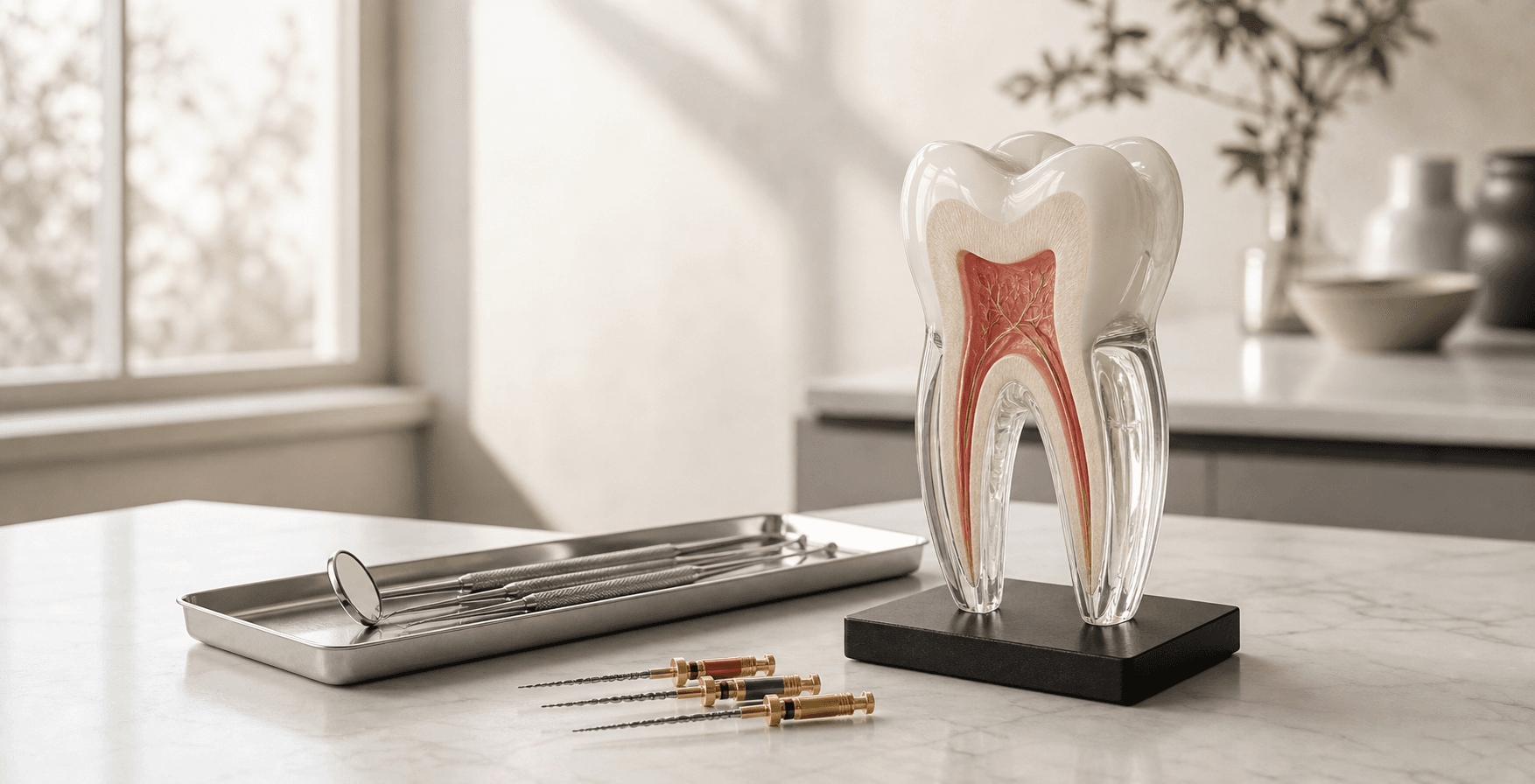
Under the hard enamel shell and the dentin beneath it, every tooth has a soft core called the pulp — a small chamber of nerves and blood vessels that runs down through the roots. The pulp did most of its important work while the tooth was forming; in an adult tooth, its main day job is sensing temperature and pressure.
The trouble starts when bacteria reach that chamber, usually through deep decay, a crack, or a filling that has broken down. Unlike the skin on your arm, the pulp sits inside rigid walls with no room to swell. When it becomes inflamed, pressure builds with nowhere to go, which is why nerve pain in a tooth can be so distinctively intense — and why, past a certain point, the tissue cannot recover on its own.
Root canal therapy exists for exactly this situation: the inflamed or infected pulp is removed, the canals inside the roots are cleaned and sealed, and the tooth itself stays in your mouth doing its job. It is the treatment that ends the pain, not the thing that causes it.
Symptom one: sensitivity that lingers
Everyone gets brief zings from ice water or hot coffee now and then. The detail your dentist cares about is what happens after the trigger is gone. Healthy-tooth sensitivity fades within a few seconds. Nerve-stage sensitivity lingers — a deep ache that hangs on for thirty seconds, a minute, sometimes much longer after the cold or heat is removed.
Heat sensitivity deserves special mention. A tooth that has become newly and intensely sensitive to hot foods and drinks, especially if cold actually starts to feel soothing, is a classic signature of a pulp in real trouble. That specific pattern tends to show up late in the process, and it is a strong signal to be seen promptly rather than waiting for it to settle.
The pattern over time matters as much as the intensity. Sensitivity that is slowly ramping up week over week — triggered more easily, lasting longer each time — is telling a story about a nerve under increasing strain, even if no single episode feels unbearable.
Symptom two: pain that shows up uninvited
Pain that needs a trigger — biting, temperature, sweets — is one category. Pain that arrives on its own is another, more serious one. A tooth that starts throbbing while you are doing nothing at all, or that wakes you at night, points strongly toward an inflamed nerve. Lying down raises blood pressure in the head slightly, which is why nerve-stage toothaches are famous for getting worse the moment you try to sleep.
Pain on biting or chewing pressure is its own clue. When an infection begins to spread past the tip of the root, the ligament that suspends the tooth in its socket becomes tender, and the tooth may feel 'taller' than its neighbours or bruised when you tap it. Some patients describe being able to point to exactly one tooth that they avoid chewing on — that kind of precision localization is diagnostically valuable, so mention it.
One deceptive twist: severe pain that suddenly stops can mean the nerve has died rather than healed. The infection is still there, now progressing silently. A toothache that vanished on its own is worth an exam, not a sigh of relief.
The quieter signs: colour changes, gum pimples, and swelling
Not every nerve problem announces itself with pain. A single tooth that gradually darkens — taking on a grey or brownish cast compared to its neighbours — often indicates that the pulp inside has died, sometimes years after an old injury. A knock during sports in your teens can surface as a discoloured, infected tooth decades later.
Another quiet sign is a small pimple-like bump on the gum near a tooth, which may come and go and sometimes releases a bad-tasting fluid. This is a drainage channel from an infection at the root tip. Because it relieves pressure, it often keeps pain minimal, which makes it easy to ignore — but it means an active infection is present and the bone around the root is involved.
Visible swelling in the gum, cheek, or jaw is the escalation stage. Facial swelling alongside a toothache is a same-day matter, and swelling that affects your eye, your ability to swallow, or your breathing is an emergency-room matter, full stop. Dental infections in those situations can become dangerous quickly.
What your dentist actually does to confirm it
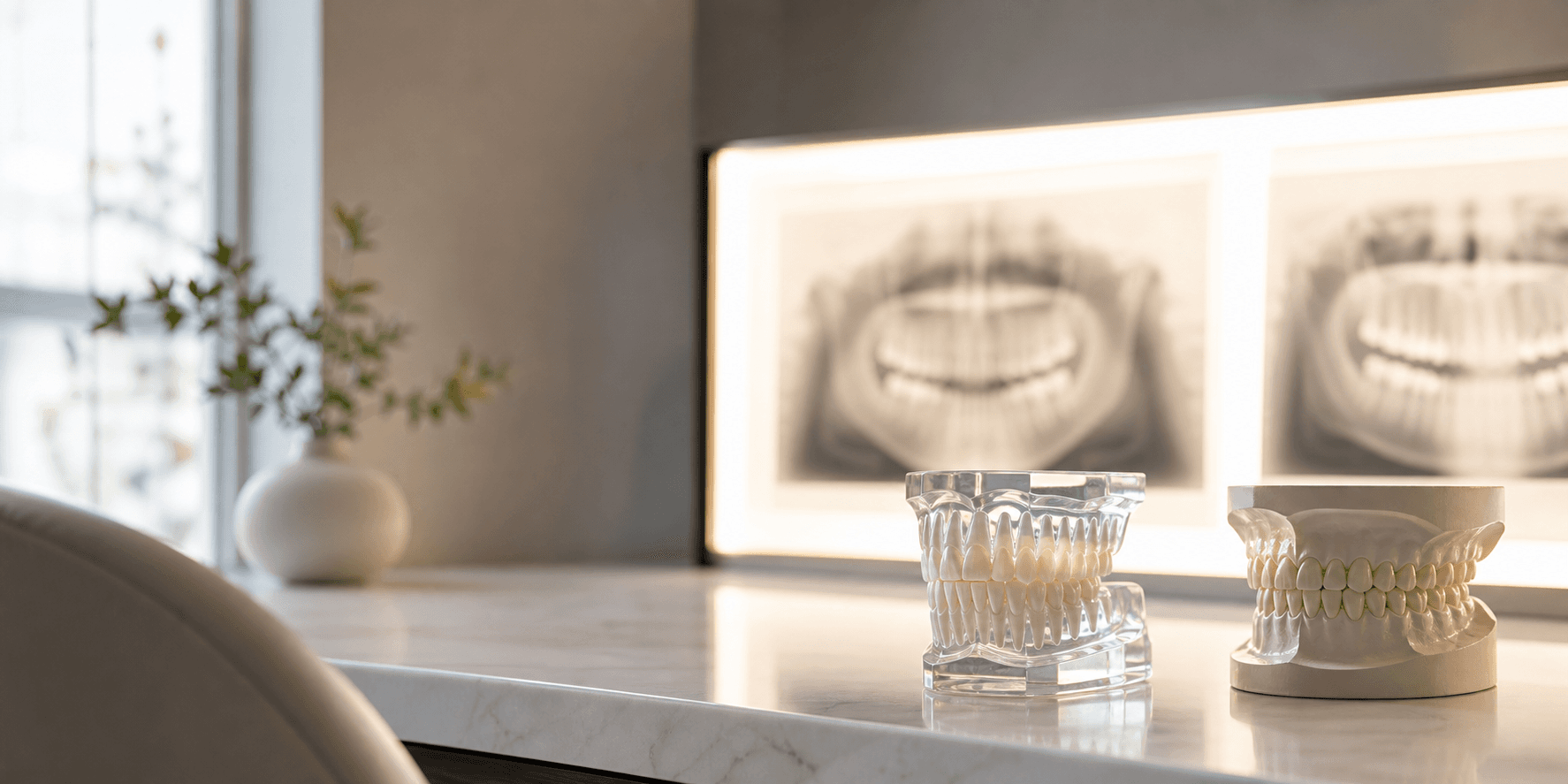
Symptoms point; testing confirms. Expect your dentist to take a focused X-ray of the suspect tooth, looking for deep decay, changes in the bone around the root tip, and the condition of any existing fillings or crowns. Digital imaging makes this quick, and at our clinic near Midland and Eglinton we routinely walk patients through the image on screen, because seeing a dark halo at a root tip yourself makes the diagnosis far less abstract.
Alongside imaging, there are simple chairside tests: a cold stimulus to measure how the nerve responds and how long the reaction lingers, gentle tapping to check ligament tenderness, and a bite test to hunt for cracks. Each result narrows things down, because a toothache can also come from sinus pressure, grinding, gum problems, or a cracked cusp that needs a different fix entirely.
That is really the point of a proper workup: not every candidate symptom ends in a root canal. Sometimes the answer is a filling, sometimes a crown, sometimes a night guard. But when the tests do confirm an irreversibly inflamed or infected pulp, treating it promptly is what saves the tooth — and modern root canal therapy, done with local anesthetic on a properly numbed tooth, feels far more like a long filling appointment than the punchline it plays in old jokes.