
Ask ten people how often you should see a dentist and nine will say every six months. It is one of the most repeated pieces of health advice in existence, passed down so consistently that it feels like a law of nature. It is not. The six-month interval is a sensible default that works well for a lot of people, but it was never meant to be a universal prescription.
The honest answer — the one a good dentist will actually give you — is that checkup frequency should match your mouth, not a calendar template. Some people genuinely do well with a visit every nine or twelve months. Others need to be seen every three or four. This post walks through how that decision actually gets made, so your recall interval feels like a plan rather than a habit.
Where the six-month rule came from
The twice-a-year convention predates most of modern dentistry's diagnostic tools. It emerged as a practical rhythm: frequent enough to catch common problems while they are still small, spaced out enough to be realistic for busy lives. For decades it served as a reasonable one-size-fits-most compromise, and for many patients it still is.
But dentistry has become far better at measuring individual risk. Digital X-rays, detailed gum measurements, and a fuller understanding of how decay and gum disease actually progress mean a dentist today can say something more precise than 'see you in six months.' They can look at your specific pattern — how fast tartar builds on your teeth, how your gums respond to cleaning, how many new cavities you have had in recent years — and set an interval that reflects it.
So the six-month visit is best understood as a starting point. It is where most people begin, and then the interval gets adjusted, in either direction, based on what your dentist and hygienist observe over time.
Who benefits from more frequent visits
Gum health is usually the biggest factor. If you have a history of gum disease — bleeding when you brush, pockets forming between the gum and tooth, bone changes on X-rays — the bacteria involved recolonize within weeks of a professional cleaning. For these patients, a three- or four-month recall is not upselling; it is the interval at which cleanings actually interrupt the disease process before it regains momentum.
Cavity-prone patients are the other major group. Some mouths simply develop decay faster, whether because of dry mouth from medications, a diet with frequent sugar exposure, deep grooves in the molars, or enamel that is naturally more vulnerable. If you have needed multiple fillings in the past couple of years, shorter intervals let your dentist catch new decay at the reversible or barely-started stage rather than the drill-and-fill stage.
Life circumstances matter too. Pregnancy shifts gum behaviour noticeably for many people. Diabetes and gum disease influence each other in both directions. Orthodontic appliances, whether braces or aligners, create new places for plaque to hide. Smokers and heavy vapers heal more slowly and mask gum inflammation. None of these automatically mean quarterly visits, but each one nudges the interval shorter.
Who can comfortably stretch the interval
On the other end of the spectrum is the patient with consistently healthy gums, no new cavities in years, minimal tartar buildup between visits, and solid daily brushing and flossing. For someone with that track record, an appointment every nine or even twelve months can be entirely reasonable, and a dentist who is confident in your stability should be comfortable saying so.
The key word is track record. A longer interval is earned by a pattern of boring, uneventful checkups — it is not a starting assumption. Skipping visits because nothing has hurt lately is a different thing entirely, since the most expensive dental problems are precisely the ones that stay silent until they are advanced. Gum disease rarely hurts until it is well established, and a cavity can reach the nerve before it ever aches.
It is also worth separating the exam from the cleaning in your mind. Some patients keep a longer interval between full exams but a shorter one between hygiene visits, or vice versa. The two serve different purposes, and your dentist can mix the rhythm to suit what your mouth actually needs.
What actually happens at a recall visit
A checkup is more than a look around. Your dentist is screening for decay between teeth and under old fillings, checking gum measurements against your previous numbers, examining existing dental work for wear and leakage, and screening the soft tissues of your mouth for anything unusual, including an oral cancer check that takes about a minute and is quietly one of the most valuable parts of the visit.
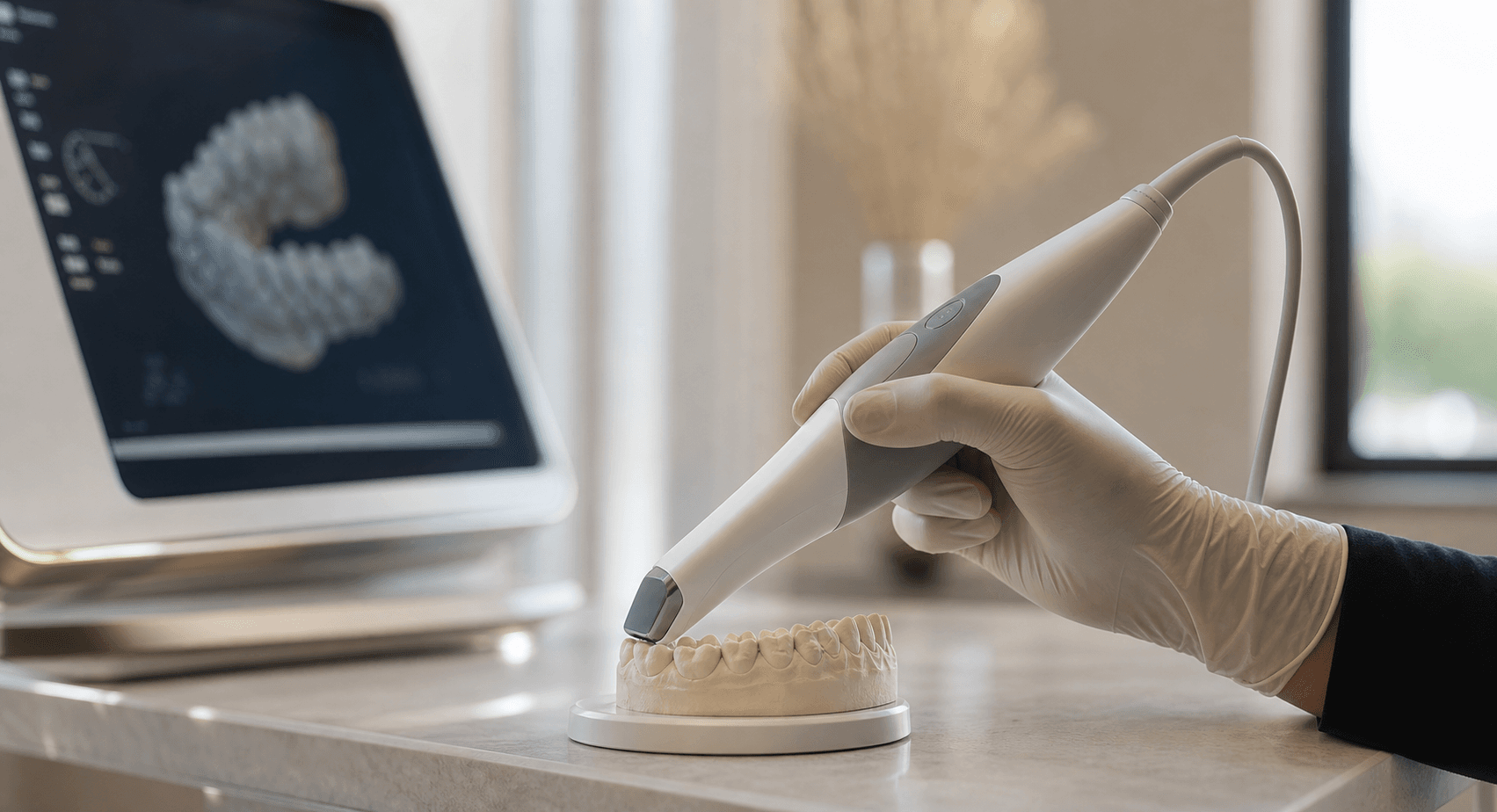
Technology has made this both faster and more precise. Digital X-rays taken at appropriate intervals reveal what no visual exam can see, and an intraoral camera lets you look at the same image your dentist is looking at, on a screen, rather than taking their word for it. At our Midland and Eglinton clinic, we find that showing patients exactly what we see changes the conversation — a recall interval makes far more sense when you can see the reason for it yourself.
The hygiene portion removes the hardened tartar that no toothbrush can, polishes away surface stain, and gives your hygienist a close look at how your home care is holding up. The advice that comes out of that — a technique tweak, a different tool for a tight spot — is often what actually moves the needle between visits.
How to find your own right answer
The simplest approach is to ask directly at your next visit: based on what you see in my mouth, what interval makes sense for me, and what would need to change for it to be longer? A dentist who tailors care will have a specific answer grounded in your gum measurements, your cavity history, and how much buildup accumulated since your last cleaning.
Expect the answer to change over time. A stretch of stressful months, a new medication that dries your mouth, a change in diet or habits — any of these can shift your risk, and your recall interval should shift with it. The goal is a rhythm that keeps problems small, and small problems are cheaper, faster, and far more comfortable to fix than large ones.
If it has been longer than you meant it to be since your last visit, that is common and entirely recoverable. Scarborough is a busy place and life fills a calendar quickly. A single thorough exam and cleaning re-establishes your baseline, and from there the schedule becomes personal again rather than something you feel behind on.