When a tooth needs repair, the conversation usually comes down to two main options: a filling or a crown. Patients sometimes assume the choice is about budget or preference, but in truth it is mostly about arithmetic — specifically, how much healthy tooth structure is left, and how much force that remaining structure will have to survive every time you chew.
Understanding that logic makes the recommendation you hear in the chair much easier to evaluate. This guide lays out what each restoration actually does, where the dividing line sits, what lives in the middle ground between them, and the honest trade-offs on both sides — so when your dentist points at an X-ray and suggests one or the other, you can follow the reasoning rather than just nodding along.
What a filling does well
A filling is a patch. Your dentist removes the decayed portion of the tooth, disinfects the area, and rebuilds the missing piece with composite resin bonded directly to the tooth, shaped and hardened on the spot. For small to moderate cavities, this is quick, conservative, and effective — the whole repair typically happens in a single visit, and modern tooth-coloured composites blend in well enough that most people cannot find their own fillings afterward.
The key advantage of a filling is how little it asks of the tooth. Only the damaged portion is removed; everything healthy stays. Dentists call this conservative dentistry, and it matters more than it sounds, because every tooth has a finite budget of structure. Each repair over a lifetime spends some of it, so the smallest restoration that genuinely solves the problem is almost always the right call.
Fillings have a structural limit, though. Composite bonds to the tooth but it does not hold the tooth together. The larger a filling gets relative to the tooth around it, the more the remaining walls of enamel are left standing like fence posts, taking the full load of chewing without much backing them up.
Where fillings start to fail
Chewing generates remarkable force, concentrated on the back teeth. A molar that is mostly filling and only partly natural tooth flexes under that load in ways it was never designed to. Over time the thin remaining walls can crack, the bond can leak, and decay can slip in around the edges of the old restoration.
This is why a dentist may decline to place a third or fourth filling in the same tooth. Replacing a large failed filling with an even larger filling often just resets the clock on the same failure, with less tooth remaining each cycle. At some point the patch is bigger than the thing being patched, and the tooth needs a different kind of help.
The warning signs of a filled tooth reaching that point are worth knowing: a filling that keeps chipping at the edges, pain when biting that goes away when you release, sensitivity around an old restoration, or visible cracks in the enamel beside a large filling. Any of these suggest the tooth needs structural protection, not another patch.
What a crown does differently
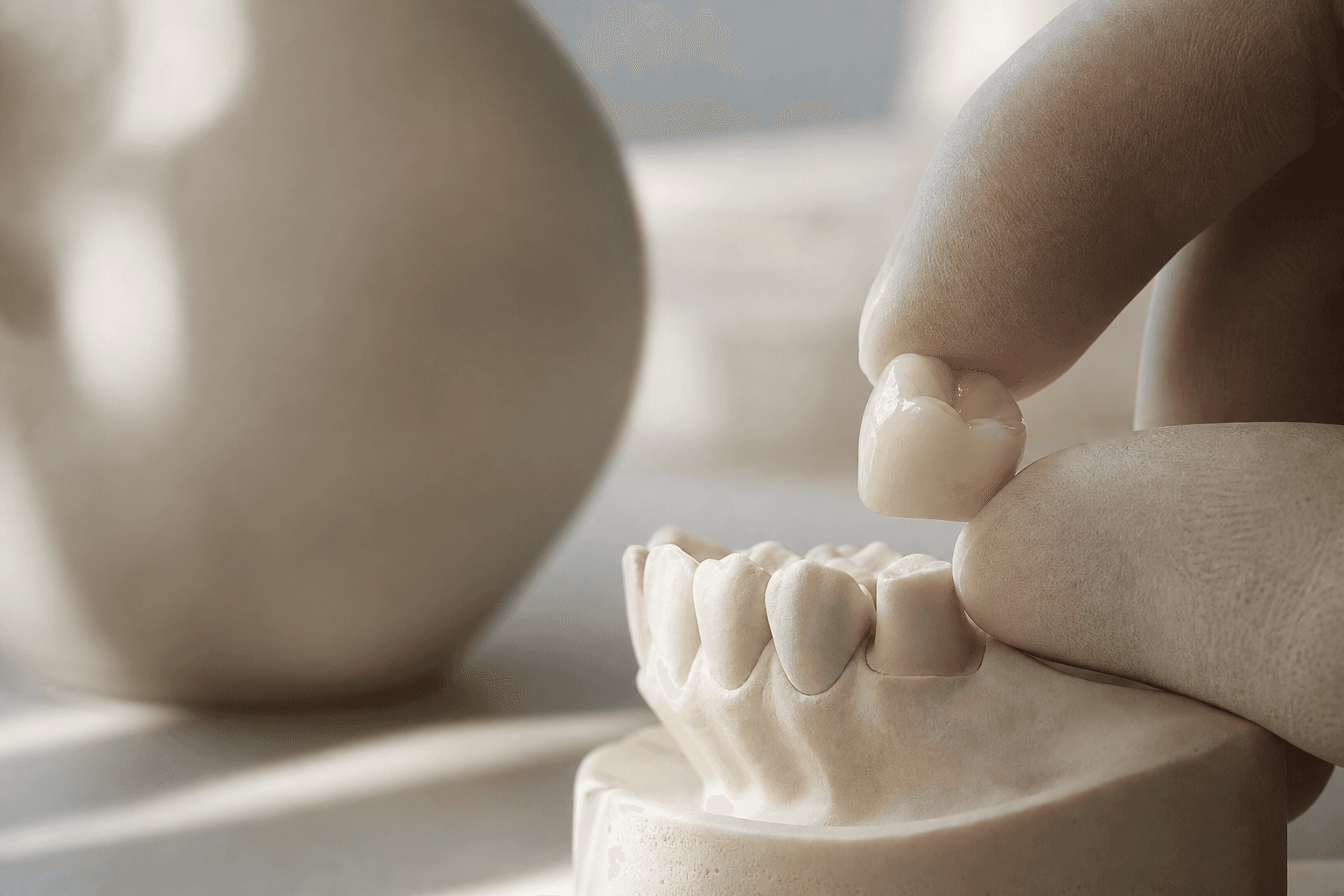
A crown is not a patch — it is armour. The dentist reshapes the damaged tooth into a stable core, then covers the entire chewing surface with a custom-made cap of porcelain, zirconia, or similar material. From that point on, biting force is distributed across the whole crown and down the axis of the tooth, rather than prying against weakened walls.
That mechanical difference is the entire argument for crowns. A cracked tooth, a tooth with a very large old filling, a tooth that has lost a cusp, or a tooth made brittle by root canal therapy all share the same problem: not enough intact structure to withstand chewing on its own. A crown holds the remaining tooth together instead of asking it to hold itself.
The trade-off is that a crown requires removing more tooth structure to make room for the cap, and it is a bigger investment of time — typically involving digital scans or impressions and precise fitting. It is genuinely the wrong choice for a small cavity, exactly as a filling is the wrong choice for a structurally compromised tooth. Neither is the 'better' restoration; they solve different problems.
The middle ground, and how the decision is actually made
Between a routine filling and a full crown sits a middle category — onlays and partial crowns — which cover and protect the damaged portion of the chewing surface while leaving more of the healthy tooth untouched. When the damage is too extensive for a reliable filling but the tooth does not need full coverage, these can be an excellent conservative compromise, and they are worth asking about.
In practice, your dentist is weighing a short list of factors: how much sound tooth remains after the decay is removed, whether cracks are present and where they run, whether the tooth has had a root canal, how heavy your bite is, and whether you grind your teeth. A grinding habit, for instance, can push a borderline tooth from filling territory into crown territory, because the nightly forces involved are far beyond normal chewing.
Good diagnostics make this a shared decision rather than a pronouncement. At our Scarborough clinic we use intraoral camera photos so you can see the crack lines or the failing filling yourself, on a screen, before any decision is made. When you can see that a tooth is more filling than tooth, the recommendation stops feeling like sales and starts feeling like physics.
Longevity, and the cost of under-repairing
Both restorations, done well and cared for, last years — crowns generally longer than large fillings, precisely because they solve the structural problem rather than living with it. Daily brushing, flossing around the margins, and regular checkups are what stretch either one toward the long end of its lifespan, since the most common failure mode for both is new decay creeping in at the edges.
The riskier path is usually under-repairing: choosing the smaller fix for a tooth that mechanically needs the larger one. A too-big filling that fractures can take a wall of the tooth with it, and a crack that propagates below the gumline can make the tooth unrestorable altogether — converting a crown-sized problem into an extraction-sized one. The most expensive restoration is the one that has to be done twice, or the tooth that cannot be saved at all.
If you are facing this decision now, ask your dentist two questions: how much natural tooth will remain after the decay is cleaned out, and what happens to that tooth if we choose the smaller option and it fails. The answers, honestly given, usually make the right choice obvious.