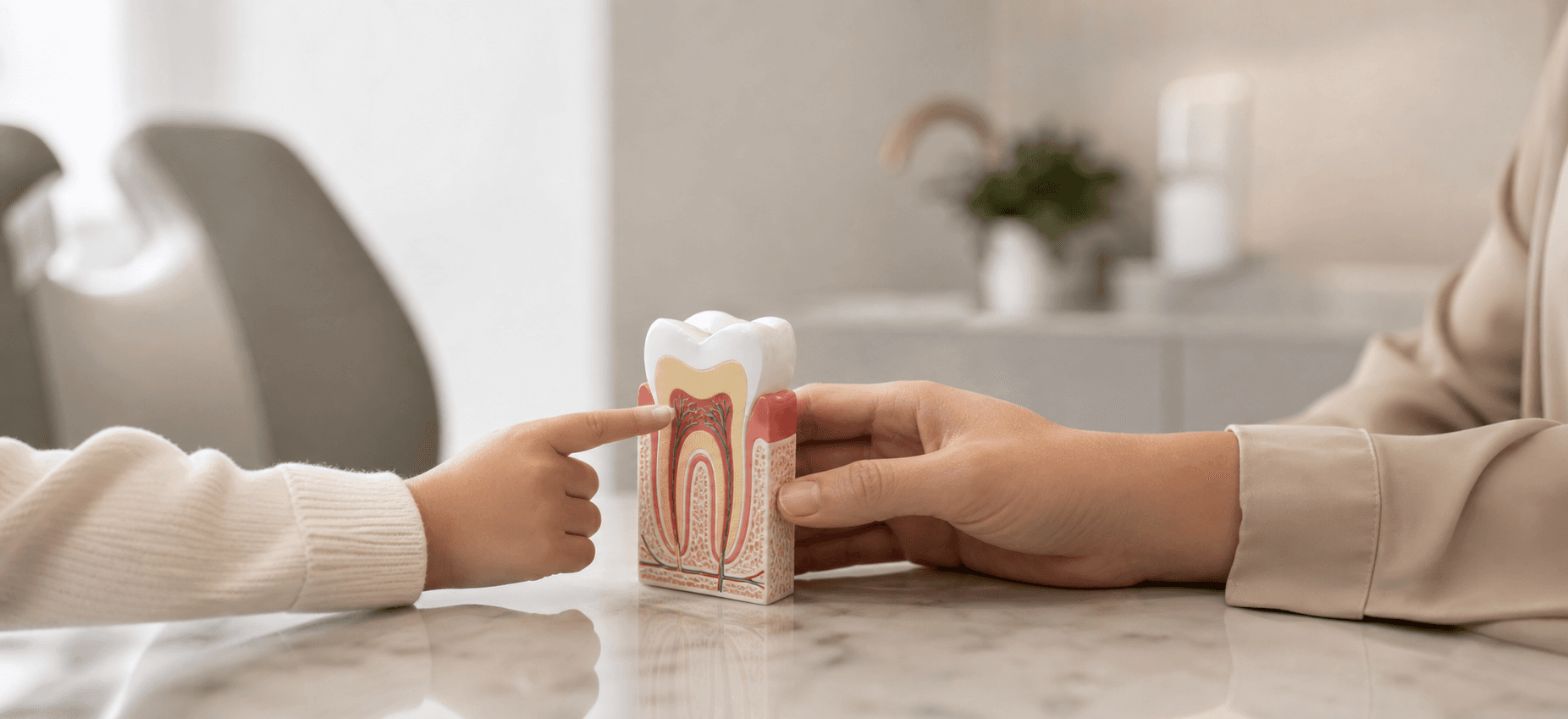

Somewhere around six months, a tiny white edge appears on your baby's lower gum, and a whole new category of parenting questions arrives with it. Do baby teeth really matter if they fall out anyway? When does brushing start? How much toothpaste is safe? And when, exactly, is a child supposed to see a dentist for the first time?
The encouraging news is that early dental care is mostly about small, consistent habits rather than complicated rules. This guide covers the essentials — why baby teeth are more important than they get credit for, how to care for them at every stage, and how to make those first dental visits the foundation of a lifetime of easy appointments.
Why baby teeth matter more than people think
It is tempting to treat baby teeth as disposable — placeholders that fall out on schedule regardless of care. In reality, they carry several jobs at once. They let your child chew a full range of foods during the most important years of growth. They shape early speech, since many sounds are formed with the tongue against the front teeth. And critically, they hold space in the jaw for the adult teeth developing underneath.
That last job is the one with long consequences. When a baby molar is lost early to decay, the neighbouring teeth drift into the empty space, and the adult tooth that was supposed to erupt there can come in crowded, tilted, or blocked entirely — a problem that often ends in orthodontics years later. Keeping baby teeth healthy until they are naturally ready to go is genuinely an investment in the adult smile.
Decay in baby teeth also moves fast. Baby enamel is thinner than adult enamel, so a small cavity can reach the nerve of a baby tooth in a fraction of the time it would take in an adult molar. This is why early dental care is proactive rather than reactive — the window between 'small spot' and 'toothache' is short in small teeth.
From gum wipes to real brushing
Care actually starts before the first tooth. Wiping your baby's gums with a clean, damp cloth after feeds keeps the mouth clean and — just as valuably — makes having something in their mouth for cleaning feel normal from the beginning. Babies who are used to this tend to accept a toothbrush far more calmly.
Once the first tooth appears, switch to a soft, small-headed infant toothbrush twice a day with a smear of fluoride toothpaste about the size of a grain of rice. From age three, when children can spit more reliably, the amount grows to a pea-sized dab. Fluoride toothpaste in these small, age-appropriate amounts is the standard recommendation from Canadian dental and pediatric bodies, and it is one of the most effective cavity-prevention tools available.
Expect to do the actual brushing yourself for years. Most children lack the fine motor control to brush effectively on their own until around age seven or eight — a useful benchmark is that a child who cannot yet tie their own shoelaces cannot yet brush their own teeth well. Letting them start and then 'finishing the job' as a parent is a routine that respects their independence while protecting their teeth.
Teething, bottles, and the habits that shape early decay
Teething is uncomfortable but manageable: chilled (not frozen) teething rings, a clean finger rubbed gently on the gums, and extra patience cover most of it. Drooling, chewing on everything, and irritability are normal; a persistent high fever is not a teething symptom and deserves a call to your doctor.
The single biggest early-decay pattern dentists see comes from sleep-time feeding habits. When a baby falls asleep with a bottle of milk, formula, or juice, the sugars pool around the upper front teeth for hours, and the result — sometimes called bottle decay — can quietly destroy the front teeth before age two. If a bedtime bottle is part of your routine, water is the only safe filler once teeth are present, and moving away from the bottle entirely around the first birthday is the standard guidance.
Sippy cups of juice carried around all day create the same slow sugar bath in an older toddler, as does frequent snacking on sticky carbohydrates. None of this requires perfection — it requires structure: sweet things with meals rather than grazing, water as the default drink, and teeth brushed last thing before sleep with nothing but water afterward.
The first dental visit: earlier and easier than most parents expect
Canadian dental guidance recommends a first visit within six months of the first tooth appearing, or by the first birthday, whichever comes first. That surprises many parents, who imagine a dentist has nothing to do for a one-year-old. In fact the first visit is short and gentle by design: a lap-to-lap look at the new teeth, a check of gums and jaw development, and — often the most valuable part — unhurried time for your questions about brushing, fluoride, soothers, and thumbs.
The deeper purpose of an early first visit is that nothing is wrong yet. A child whose first dental memory is a friendly count-your-teeth game builds a completely different relationship with dental care than a child whose first visit happens at age four with a toothache. The early visits are, in a very real sense, anxiety prevention — for the child and often for the parent too.
As children grow, visits expand naturally: gentle cleanings, fluoride varnish where appropriate, and eventually sealants on the deep grooves of new adult molars, which are a simple and well-established way to protect the most cavity-prone surfaces in a child's mouth. Each step gets introduced when the child is ready for it, not before.
Raising a kid who is genuinely fine with the dentist
Children read their parents fluently. If dental visits are discussed at home as neutral, ordinary events — like a haircut — children tend to treat them that way. The words matter more than most people expect: avoid the vocabulary of warnings ('it won't hurt', 'be brave', 'no needles today'), because each of those sentences introduces an idea the child had not thought to worry about.
Practical framing helps. Reading a picture book about a dental visit beforehand, playing 'dentist' with a stuffed animal at home, and scheduling appointments at your child's best time of day — usually mornings, never nap time — all stack the odds toward a calm visit. If your own dental anxiety is significant, it is completely fine to have the other parent or a grandparent take point on appointments while you work on your own relationship with the chair.
Families around Midland and Eglinton have been raising kids in this neighbourhood for generations, and our team sees the full range of first-visit personalities — the fascinated, the shy, the loudly unconvinced. All of them are normal, and all of them come around with patience and the right pacing. A child's early years with the dentist are a relationship being built, and like any relationship, it is built on repeated good experiences rather than a single perfect one.