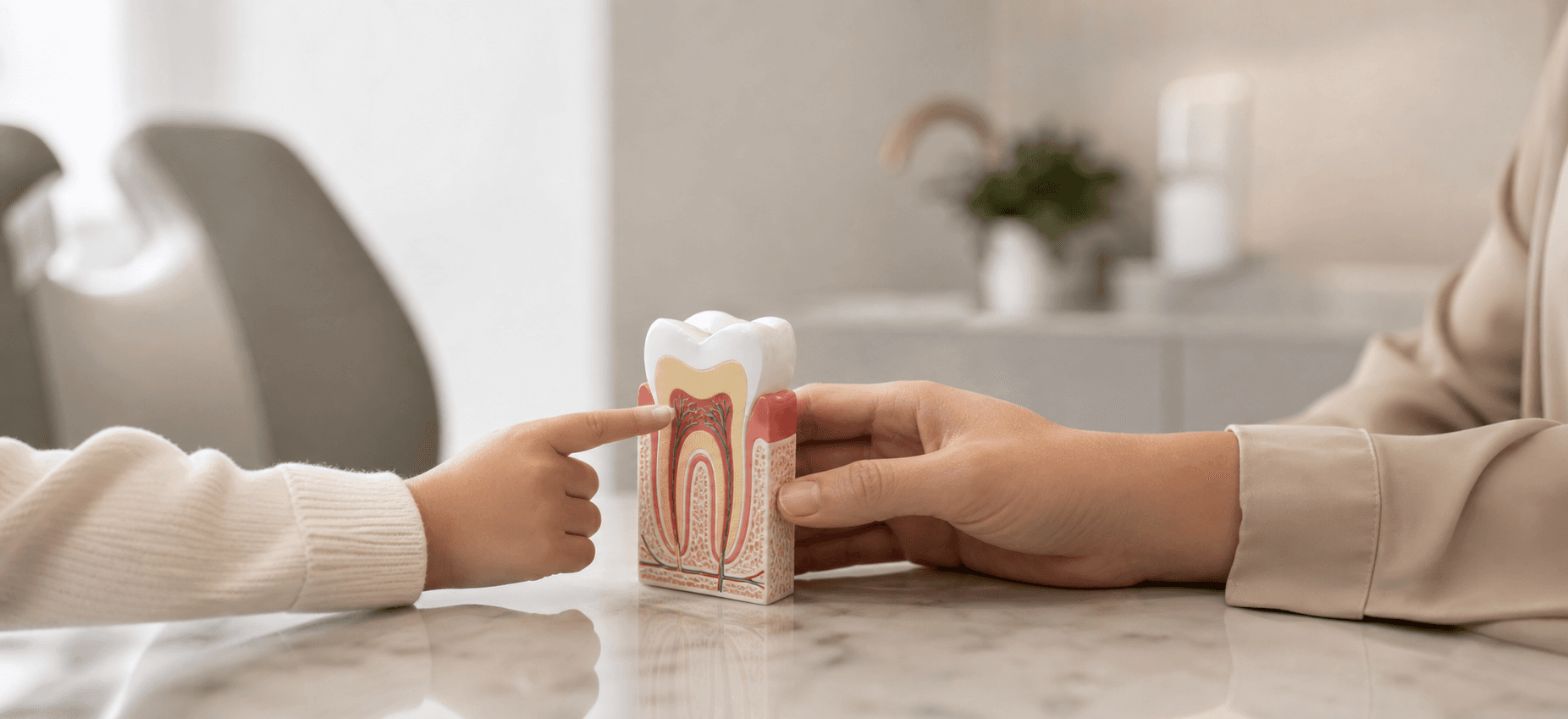

Few things prompt as much late-night phone scrolling as a baby's first tooth — or the wait for it. Parents around Scarborough ask the same reasonable questions: when should teeth start showing up, in what order, and how do I know if we are on track? The good news is that baby teeth follow a broadly predictable pattern, and the even better news is that the pattern is loose enough to accommodate almost every healthy child.
Your little one will get twenty primary teeth in all, and they tend to arrive in waves over the first couple of years, generally from the front of the mouth toward the back. This guide lays out the usual sequence, explains why the timing wanders so much from child to child, and covers the teething signs, the soothing that helps, and the reasons these small, temporary teeth deserve real attention.
One thing to hold onto before we start: the ages below are averages, not deadlines. A tooth that shows up months earlier or later than the chart says is almost always just fine.
The general timeline, front to back
Baby teeth usually erupt in a fairly orderly march, and it helps to picture it in stages. First to arrive, generally between about six and ten months, are the two lower central incisors — the bottom front teeth. The four upper front teeth, the central and lateral incisors, tend to follow between roughly eight and twelve months, and the lower lateral incisors round out the front set not long after.
Next come the first molars, the wider teeth further back, usually somewhere between thirteen and nineteen months, with the upper pair often appearing a little ahead of the lower. Then the canines — the pointed teeth that fill the gap between the incisors and molars — typically emerge between about sixteen and twenty-three months. Finally, the second molars at the very back arrive last, generally between two and three years of age, completing the full set of twenty.
So the rough order is: lower front teeth, upper front teeth, the rest of the incisors, first molars, canines, and second molars last. Most children have all twenty primary teeth by around age three. If your child's sequence shuffles a little or a tooth arrives out of the expected order, that alone is rarely cause for concern.
Why timing varies so much — and why that's normal
If you compare notes with other parents, you will hear wildly different stories: one baby cutting a tooth at four months, another still gummy at their first birthday. Both can be perfectly healthy. Eruption timing is strongly influenced by genetics, so if you or your partner were early or late teethers, your child may well follow suit. There is a wide window of normal, and being at either edge of it says nothing about how your child is developing overall.
What matters more than the calendar is the pattern over time. Teeth that come in reasonably in sequence, gums that look healthy, and a child who is otherwise eating and growing well are all reassuring signs, even if the dates do not match a chart precisely. Try not to turn the milestone into a race — comparison with the baby next door is the surest route to needless worry.
Teething signs and gentle soothing
As a tooth pushes through the gum, many babies become fussier than usual. Common signs include drooling more than normal, wanting to chew on everything within reach, sore or slightly swollen gums, irritability, and disrupted sleep. These tend to come and go around the time each tooth erupts rather than lasting for months on end.
For soothing, simple and safe options work best. A clean, chilled (not frozen) teething ring gives something firm to gnaw on, and a clean finger or a cool, damp cloth rubbed gently on the gums can offer relief. Chilled soft foods may help an older baby. It is worth knowing that a high fever, diarrhea, or a rash are not typical of teething — if your baby seems genuinely unwell, that points to something else and is worth checking with a healthcare provider rather than chalking it up to teeth.
Why baby teeth matter more than they look
It is tempting to think baby teeth are throwaway placeholders, since they all fall out eventually. They are not. Each primary tooth holds space in the jaw for the adult tooth forming beneath it, acting as a natural guide so the permanent teeth have room to come in straight. When a baby tooth is lost too early to decay, neighbouring teeth can drift into the gap and crowd out the adult tooth that was meant to take its place.
Baby teeth also do real daily work. They let a child chew a full range of foods, they shape how sounds are formed as speech develops, and they contribute to a confident smile at an age when children are learning to be social. Healthy primary teeth make for a smoother handoff to the adult set, which is why cavities in baby teeth are worth preventing and treating rather than waiting out.
When adult teeth arrive and the first dental visit
The permanent teeth generally begin to appear around age six, often starting with the first adult molars coming in behind the baby teeth and the lower front baby teeth becoming loose. From there, primary teeth are gradually shed and replaced over several years, wrapping up in the early teens for most children. The wobbly-tooth years are a normal, healthy stage, not something to hurry along.
Dental visits should start earlier than many parents expect. The general guidance is to bring a child in by their first birthday, or within about six months of that very first tooth appearing — whichever comes first. These early visits are gentle and mostly about getting comfortable: checking that things are developing well, spotting any concerns early, and giving you tailored tips on cleaning those first teeth. Starting young helps a child grow up seeing the dentist as a familiar, unscary part of life.
When to call about late teeth
Because the normal window is so wide, a delay of a few months rarely means anything is wrong. That said, it is reasonable to check in if no teeth at all have appeared by around eighteen months, since a professional can confirm everything is developing as it should and rule out the rare underlying causes. A quick look provides peace of mind more often than not.
It is also worth a conversation if teeth are erupting in a very unusual order, if the gums look persistently inflamed, or if you simply have questions you would like answered by someone who can see your child's mouth. There is no wrong reason to ask — flexible scheduling means an early, low-pressure visit is easy to arrange, and reassurance from an exam beats guessing from a chart every time.